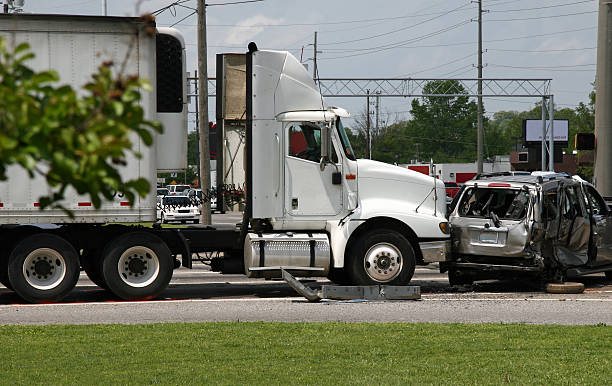
Fatigue can become an important issue when investigating a serious 18-wheeler accident. Commercial truck drivers may spend long hours on the road, but federal regulations limit how long many drivers can drive and remain on duty before they must stop.
These regulations are known as Hours-of-Service (HOS) rules. After a Louisiana truck accident, reviewing a driver's hours can help determine whether the driver was operating within federal limits and whether fatigue or scheduling practices should be investigated further.
What Are Hours-of-Service Rules?
Hours-of-Service rules are federal regulations that limit driving and on-duty time for commercial motor vehicle drivers and establish required periods of rest.
The Federal Motor Carrier Safety Administration (FMCSA) regulates Hours of Service for drivers and motor carriers subject to these requirements.
The rules vary depending on the type of commercial vehicle and operation. For drivers of property-carrying commercial vehicles, which includes many tractor-trailer and 18-wheeler drivers, several important limits may apply.
How Long Can a Truck Driver Drive?
For many property-carrying commercial truck drivers, the basic federal Hours-of-Service limits include:
- 11-Hour Driving Limit: A driver may drive for up to 11 hours after having at least 10 consecutive hours off duty.
- 14-Hour Driving Window: A driver generally cannot drive beyond the 14th consecutive hour after coming on duty following 10 consecutive hours off duty. Most off-duty periods during the workday do not simply stop or extend this 14-hour window.
- 30-Minute Break: A driver must take a break of at least 30 consecutive minutes after 8 cumulative hours of driving without a qualifying 30-minute interruption. The break does not necessarily have to be completely off duty. Certain non-driving periods may satisfy the requirement.
- 60/70-Hour Limit: Depending on the motor carrier's operation, a driver generally cannot drive after accumulating 60 hours on duty during 7 consecutive days or 70 hours during 8 consecutive days. A driver may restart the 7- or 8-day calculation after taking at least 34 consecutive hours off duty.
These are general federal rules for property-carrying drivers. Exceptions and special provisions may apply depending on the driver, vehicle, cargo, route, and circumstances.
What Is an Hours-of-Service Violation?
An HOS violation can occur when a driver operates a commercial vehicle outside the driving limits allowed by federal regulations.
For example, an investigation may reveal that a driver continued driving after reaching the applicable 11-hour driving limit or drove beyond the allowed 14-hour window.
But the investigation should not necessarily stop with the driver.
Trucking companies have responsibilities under federal safety regulations as well. A motor carrier generally cannot permit or require a driver to operate a commercial vehicle in violation of applicable Hours-of-Service limits.
Federal regulations also prohibit certain parties from coercing drivers to violate specified federal safety regulations, including Hours-of-Service requirements.
In a truck accident case, this can make company records important. Dispatch instructions, delivery schedules, text messages, emails, trip records, and other communications may help show what instructions the driver received and whether the schedule could reasonably be completed while following applicable safety rules.
How Are Hours-of-Service Violations Discovered?
A truck driver's Electronic Logging Device (ELD) can be one of the most important places to begin.
ELDs automatically record certain information related to driving time and duty status. An attorney can review these records to determine what the driver reported and when the truck was being driven.
However, an ELD should not always be examined by itself.
Depending on the case, an attorney may compare ELD records with other evidence, including:
- dispatch and trip records;
- bills of lading and delivery documents;
- fuel receipts;
- toll records;
- GPS or fleet telematics information;
- driver communications;
- inspection records;
- hotel, meal, or other time-stamped receipts; and
- available electronic data from the truck.
Comparing different sources of evidence can help identify inconsistencies in a driver's timeline.
For example, if a driver's log reports that the driver was off duty at a particular time, other records may help determine whether that account is consistent with the driver's actual activities.
Does an HOS Violation Prove the Driver Caused the Accident?
Not automatically.
An Hours-of-Service violation can be important evidence, but the existence of a violation does not by itself establish exactly why an accident happened.
An attorney still needs to investigate the circumstances surrounding the collision and determine how the violation relates to the crash.
For example, if the evidence shows that a driver exceeded an applicable driving limit, an investigation may also examine the driver's activities before the collision, the amount of rest the driver received, the driver's actions immediately before impact, witness observations, dash-camera footage, and other available evidence.
This is an important distinction because being within the federal driving limit does not necessarily mean a driver was well rested, and exceeding a limit does not automatically establish that fatigue caused a particular collision.
The complete circumstances matter.
Can a Trucking Company Pressure a Driver to Violate HOS Rules?
Federal regulations prohibit motor carriers and certain other parties from coercing commercial drivers to violate specified federal safety requirements.
For example, a problem may arise when a driver is given a delivery schedule that would require an HOS violation and is threatened with losing work, pay, loads, or other employment opportunities after raising the safety issue.
In a serious truck accident case, this is one reason attorneys may investigate more than the driver's conduct. Evidence concerning company policies, dispatch practices, delivery expectations, compensation, and communications with the driver may also be relevant.
Are There Exceptions to Hours-of-Service Rules?
Yes. Hours-of-Service regulations contain exceptions and special provisions, so the basic 11-hour and 14-hour limits should not be applied to every trucking accident without examining the circumstances.
One example is the adverse driving conditions exception. When its requirements are satisfied, a property-carrying driver may extend both the 11-hour driving limit and the 14-hour driving window by up to two hours.
The rules also contain provisions involving short-haul operations and sleeper-berth periods, among others.
The existence of an exception does not mean it automatically applies simply because traffic was heavy or the weather was poor. The facts surrounding the driver's trip should be examined before determining whether an exception was available.
Why Should HOS Evidence Be Preserved Quickly?
Commercial trucking cases can involve large amounts of electronic and business information, and some records may be subject to limited retention periods.
After a serious collision, an attorney may send a preservation or spoliation letter notifying the trucking company and other appropriate parties that evidence related to the accident should be preserved.
Depending on the circumstances, a preservation request may include ELD records, dispatch information, driver communications, GPS or telematics information, dash-camera footage, ECM or other vehicle data, maintenance records, inspection records, driver qualification information, and other relevant documents.
Preserving these records early gives an attorney a better opportunity to reconstruct what happened before the collision.
How Can an Attorney Determine Whether Fatigue Was Involved?
A driver does not have to exceed the 11-hour driving limit for fatigue to become an issue.
A driver may technically be within an HOS limit but still be tired because of inadequate sleep, irregular sleep schedules, demanding work conditions, or other circumstances.
For that reason, an investigation may consider the driver's ELD records together with other available evidence, including work schedules, prior duty periods, communications, video footage, witness statements, and the driver's actions before the collision.
The goal is not simply to find a violation. It is to understand what the driver was doing before the crash, how long the driver had been working and driving, and whether fatigue or an HOS violation played a role in what happened.
Injured in an 18-Wheeler Accident in Louisiana?
Truck accident claims can involve federal safety regulations, commercial insurance policies, trucking-company records, electronic evidence, and multiple potentially responsible parties.
At Jacqueline Scott & Associates, we investigate the circumstances surrounding serious commercial truck accidents, including whether applicable Hours-of-Service requirements were followed and whether important electronic and company records should be preserved.
If you or a loved one has been injured in an 18-wheeler or commercial truck accident in Shreveport, Bossier City, or elsewhere in Louisiana, contacting an attorney early can be important. Evidence that may help explain what happened can become more difficult to obtain as time passes.
A careful investigation of the driver's hours, electronic records, company practices, and other evidence can help determine what happened and who may be legally responsible.